
Average Typing Speed: What Is a Good WPM?
The average adult types about 38 words per minute (WPM) on a computer and about 29 on a phone. Those are the medians from a January 2026 study of 10,613 US adults chosen to represent the country, the only typing test of a representative sample we found, with speeds adjusted for errors. People who take online typing tests are faster. The largest study of them, 168,960 volunteers tested by researchers at Aalto University and the University of Cambridge, found an average of 52 WPM.
A good typing speed is 60 WPM or more. That's faster than about 3 in 4 US adults and about 2 in 3 typing-test takers, and it meets almost every typing requirement in the job postings we checked; only some legal secretary and medical transcription jobs ask for more. 80 WPM puts you in roughly the fastest 10 percent of typing-test takers, and 100 WPM in roughly the fastest 1 percent. If you haven't measured yourself yet, take our 1-minute typing test and find your row below.
What is a good typing speed? A WPM chart
| Your speed | How it compares | Jobs it meets |
|---|---|---|
| Under 25 WPM: slow | Slower than about 3 in 4 US adults | Almost none |
| 25 to 39 WPM: below average | Below the US adult median of 38 | From 35, some dispatcher, school office and legal clerk jobs |
| 40 to 59 WPM: average to above average | Above the US median; the typing-test average is 52 | The 40 WPM federal and California clerical standard |
| 60 to 79 WPM: good | Faster than about 3 in 4 US adults and 2 in 3 typing-test takers | Almost all, including legal secretary jobs at 60 to 70 |
| 80 to 99 WPM: fast | Faster than about 9 in 10 typing-test takers | All we found |
| 100 WPM and up: exceptional | Roughly the fastest 1 percent of typing-test takers | All we found |
How we got these. The US adult figures come from the 2026 study's published quartiles for typing on a computer: 24.1, 37.8 and 55.8 WPM. The typing-test figures are our estimate from the Aalto study's published average (51.56 WPM) and spread (a standard deviation of 20.2), assuming a bell curve. That curve reproduces the study's own cut-offs for its slowest and fastest 10 percent (about 26 and 78 WPM), though the real distribution has a slightly longer fast tail. The job column comes from real postings, covered further down.
Is 30 WPM good?
No, 30 WPM is below average. It's under the US adult median of 38, faster than fewer than 1 in 5 typing-test takers, and short of the 35 WPM that the dispatcher, school office and legal clerk postings we found ask for. At this speed the usual gains come from looking at the screen instead of the keys and using more fingers.
Is 40 WPM good?
40 WPM is average. It's just above the US adult median of 38, though slower than around 7 in 10 typing-test takers. It meets the most common job requirement we found, the US federal and California standard of 40 WPM over 5 minutes, as long as you keep your errors down.
Is 60 WPM good?
Yes, 60 WPM is good. It's faster than about 3 in 4 US adults and about 2 in 3 typing-test takers, and it meets almost every typing requirement in the job postings we checked. Past this point, more speed changes little for most people, because, as we show below, real writing runs far slower than a typing test.
Is 70 WPM fast?
Yes. 70 WPM is faster than about 4 in 5 typing-test takers, and faster than the average of all 8 kinds of typist the Aalto study identified (the fastest group averaged 68.4). The fastest 10 percent starts near 78.
Is 100 WPM fast?
Yes, very. 100 WPM puts you in roughly the fastest 1 percent of typing-test takers and above the 89.6 WPM average of the Aalto study's fastest 10 percent. The fastest people in that study reached 120 WPM or more.
Average typing speed: what the studies measured
Four large studies give four different averages, because each measured different people in a different way:
| Study | Who | Test | Result |
|---|---|---|---|
| Hernandez and colleagues, Scientific Reports, 2026 | 10,613 US adults in a panel built to represent the country | One sentence, on their own computer or phone | Median 37.8 WPM on a computer, 29.4 on a phone |
| Dhakal and colleagues, CHI 2018 | 168,960 volunteers on a typing-test site | 15 short sentences | Average 51.56 WPM |
| Palin and colleagues, MobileHCI 2019 | 37,370 volunteers on phones | 15 short sentences | Average 36.17 WPM |
| Schuurman and colleagues, The BMJ, 2022 | 2,690 staff at a Dutch hospital group | 60 seconds copying a Dutch text | Average 60.1 WPM |
The 2026 study is the one built to represent everyone: its panel, the Understanding America Study, recruits US adults by address-based sampling. So its median of about 38 is the best answer to "what is the average typing speed". It has limits. The test was a single sentence ("The quick brown fox jumps over the lazy dog."), the panel members picked their own device (5,835 typed on a computer and 4,778 on a phone), the speeds are adjusted for accuracy (speed multiplied by the share typed correctly), which lowers them, and the published quartiles don't appear to be weighted. The authors also say an online panel may be more comfortable with technology than the country as a whole.
The Aalto study is the largest and the most detailed. About 406,000 people started its test over three months and 193,000 finished it; after removing runs with more than 25 percent errors or technical problems, 168,960 remained. The clock ran from each sentence's first keypress to its last, so reading time didn't count. But the people were a typing-test crowd: their average age was 24.5, 75 percent were between 11 and 30, 68 percent were in the US, and 72 percent had taken a typing course. The authors say the sample "represents people interested in testing and developing their typing skills." That's why 52 is a good benchmark if you take typing tests, and too high for adults in general.
The hospital study cuts the other way. Its staff weren't typing enthusiasts: they were urged to take part whatever they thought of their typing skills. Yet they averaged 60 WPM, adjusted for errors, faster than either volunteer study. They were young (72 percent were under 40), they write notes and reports as part of their work, and the test lasted only a minute. Who you measure matters more than whether they volunteered.
Where the 40 WPM figure comes from
Most pages that quote 40 WPM as the average give no source. We traced it to two places, both much older and smaller than the studies above.
The first is the Keystroke-Level Model, a way of predicting how long computer tasks take, by Stuart Card and Thomas Moran of Xerox PARC and Allen Newell of Carnegie Mellon, published in a 1979 Xerox PARC report and in Communications of the ACM in 1980. Its table of keystroke times lists an "average non-secretary typist (40 wpm)", the average of the non-secretaries among 28 users in their experiment, who each took five one-minute typing tests. The model became a standard tool in interface design, and its 40 WPM typist came with it.
The second is a 1997 article by Teresia Ostrach, who ran a staffing agency in Orlando, Florida. She analyzed the best typing-test scores of 3,475 clerical job applicants from 1993 to 1997: five minutes, backspace switched off, best of two tries. Their mean was 40 WPM and their median 38. She warned that because only each applicant's best score was kept, the average "could even be lower than what was revealed". By 2007 a Columbia University computer science paper was citing her for "an average person who types 40 words per minute".
The US federal government's typing standard for clerk-typists is also 40 WPM, which keeps the number in circulation. The figure started from small groups, but the 2026 representative study landed close to it: a median of 37.8 on a computer.
Why your test score is faster than your real writing
A typing test measures copying, and most of what people type isn't copied. The Aalto researchers chose a copying task on purpose, because it measures hand and finger movement "independent of the cognitive factors related to text generation, editing, or proofreading." Your test score is your top speed with the thinking taken out.
When you write your own words, the thinking comes back. In a 1999 study at IBM, Clare-Marie Karat and colleagues timed 12 knowledge workers, all experienced computer users "with good typing skills", on two kinds of task at the keyboard. Copying a text, they produced 32.5 corrected words per minute. Composing their own replies to messages, the same people produced 19.0, about 42 percent slower. Corrected words per minute counts the words in the finished text and includes the time spent fixing mistakes. The participants were also asked to think aloud as they worked, which probably slowed both tasks somewhat, so read the numbers for the gap between them rather than as speeds you'd see at your desk.
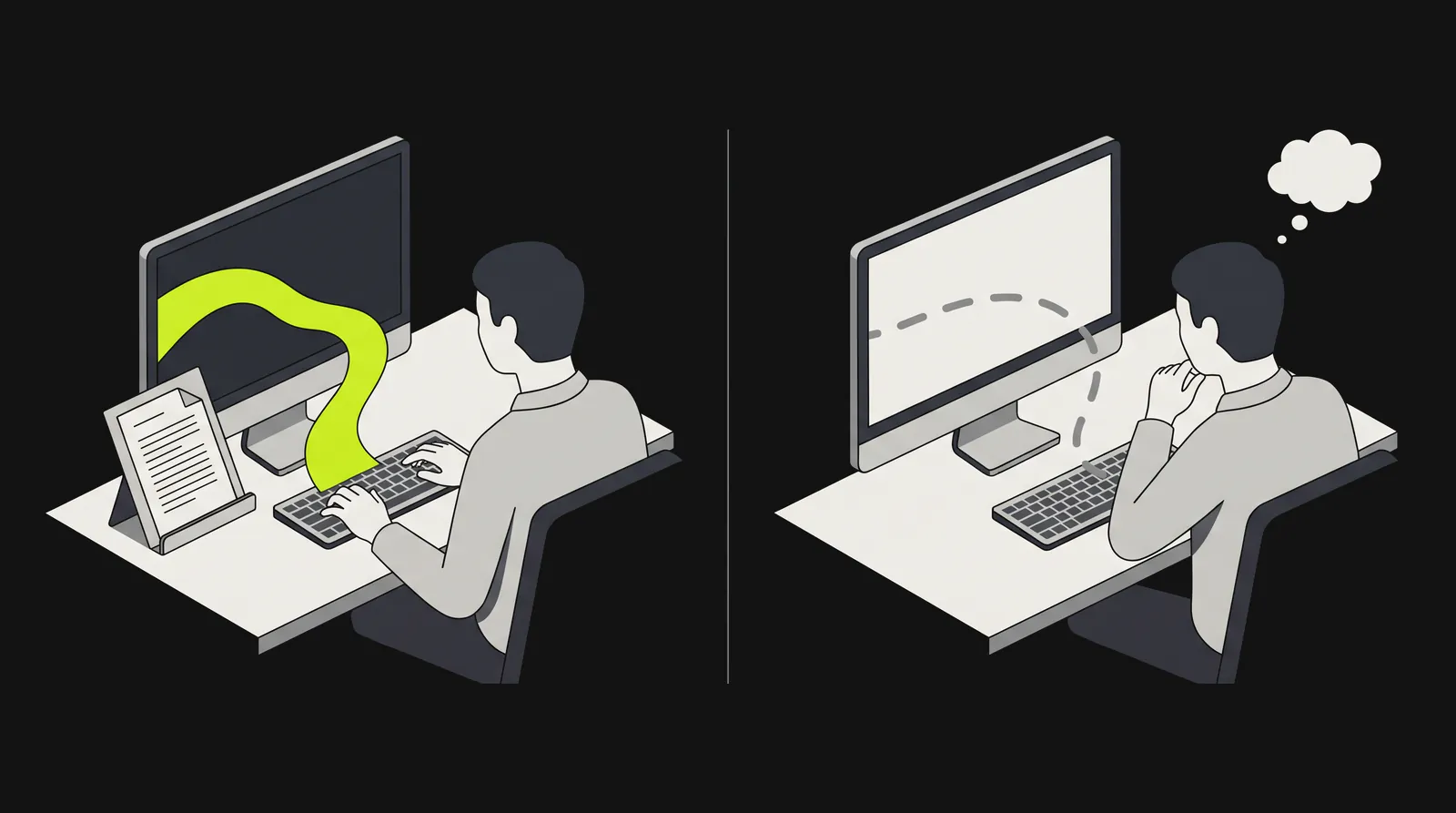
A typing test measures copying. When you write your own words, the thinking comes back, and your speed drops.
Typists notice the same thing in themselves. As one put it on the r/typing forum: "I think I type slower because I have to think about what I write. I can do 70's if I am copying." Going from 50 to 60 WPM on a test changes how fast your fingers move. It doesn't change how fast you decide what to say. The hospital study points the same way: how staff felt about their paperwork wasn't related to how fast they typed.
How WPM is calculated, and why two tests give different numbers
Typing tests and the research behind them count a word as 5 characters, spaces and punctuation included, so "Hello world" (11 characters) counts as 2.2 words. That convention makes scores comparable. What tests disagree on is everything around it:
- Mistakes. Gross WPM counts everything you typed. Net WPM takes errors off: the Los Angeles City Attorney's office, for example, scores its 5-minute test by deducting 1 WPM for each error, so 50 gross WPM with 4 errors is 46 net. Adjusted WPM, used by the 2026 and hospital studies, multiplies speed by accuracy. Our typing test counts only the characters you typed correctly.
- Length. A 15-second or 1-minute score is a sprint. Job tests usually run 5 minutes, so practice at the length you'll be tested at.
- When the clock starts. Starting at the first keypress, as the Aalto study did, leaves out reading time. Starting when the text appears includes it.
- The text. Short, common sentences are easier than passages full of numbers, capital letters and punctuation.
- The device. A desktop keyboard, a laptop and a phone give different results for the same person.
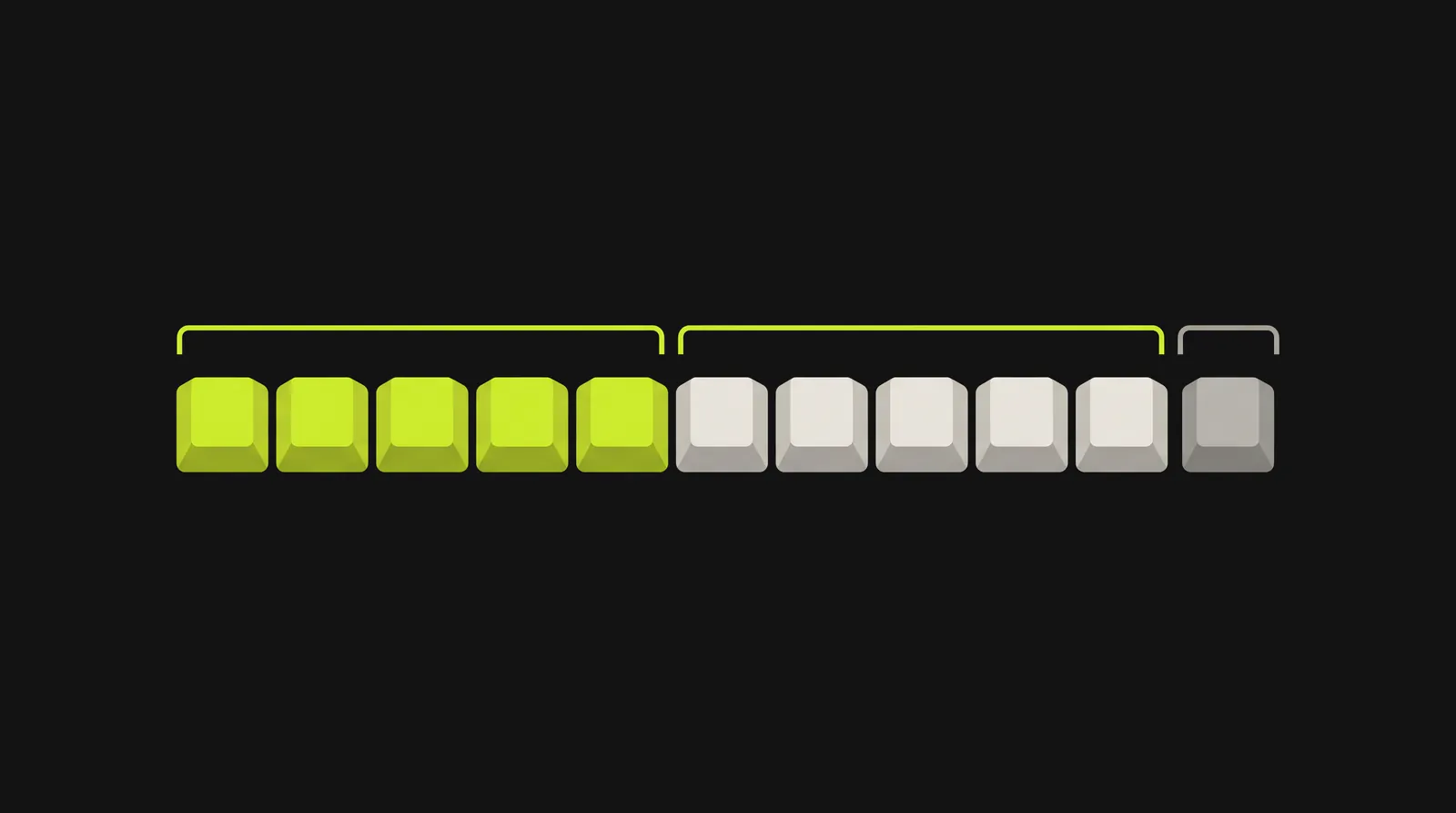
Typing tests count every 5 characters, spaces and punctuation included, as one word: "Hello world" (11 characters) counts as 2.2 words.
Average typing speed on a phone
The average typing speed on a phone is about 30 to 36 WPM. The 2026 representative study found a median of 29.4 adjusted WPM. The Aalto group's 2019 phone study of 37,370 volunteers, using the same method as its keyboard study, found an average of 36.17, with 75 percent under about 44 WPM and the fastest over 80. That's about 15 WPM slower than the same kind of volunteers on a keyboard. Phone typists also left about twice as many errors behind (2.34 percent of characters, against 1.17 on a keyboard), which the authors put down to fixing a typo on a touchscreen taking more effort.
How you hold the phone matters more than anything you learned on a keyboard. People typing with both thumbs averaged 38.0 WPM; people using one finger averaged 29.2. Having taken a touch-typing course made no real difference on a phone. People who used autocorrect were faster on average, and people who tapped word suggestions were slower. Age matters too:
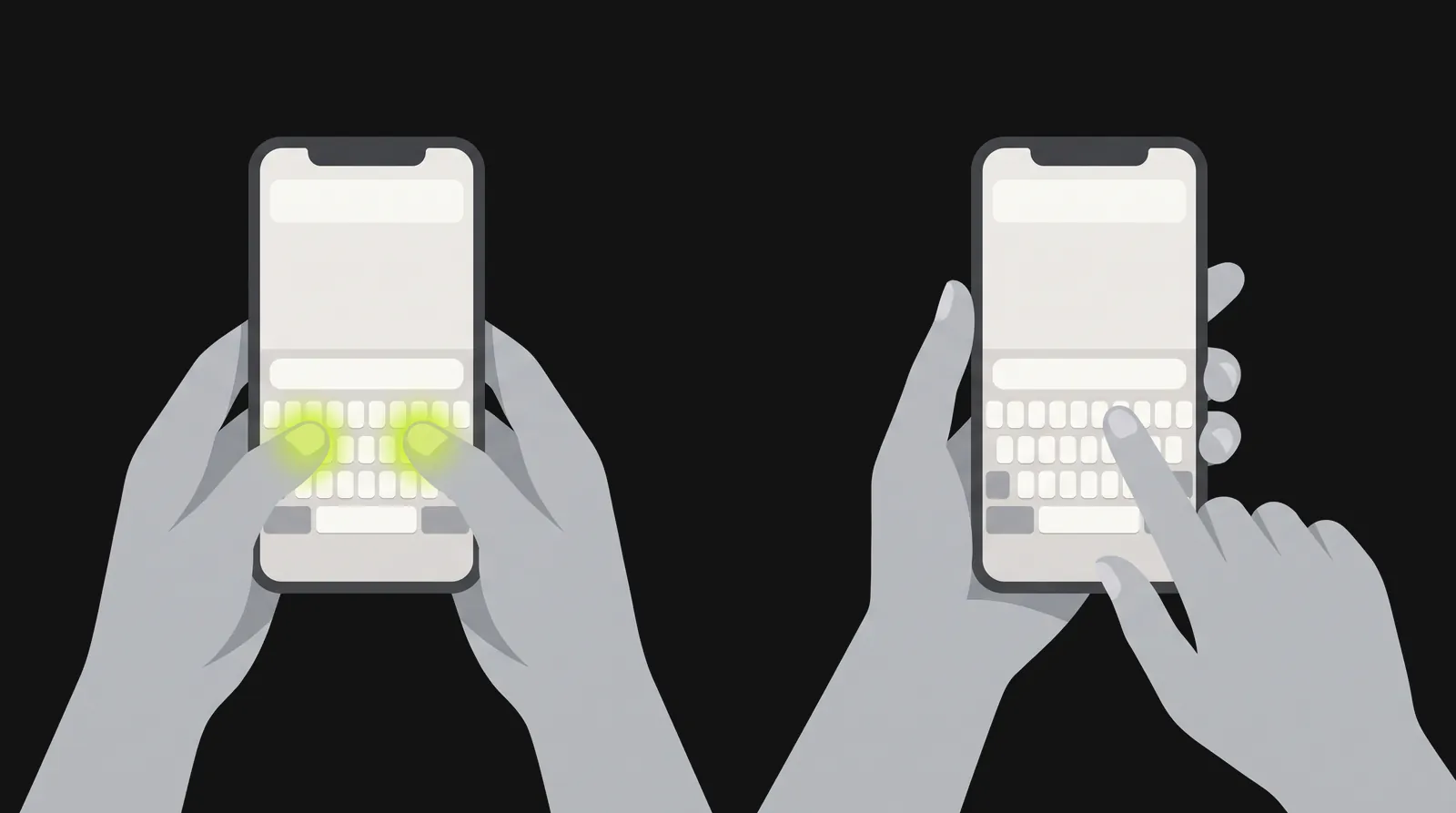
People typing with both thumbs averaged 38.0 WPM; people using one finger averaged 29.2.
| Age | Average phone typing speed |
|---|---|
| 10 to 19 | 39.6 WPM |
| 20 to 29 | 36.5 WPM |
| 30 to 39 | 32.2 WPM |
| 40 to 49 | 28.9 WPM |
| 50 to 59 | 26.3 WPM |
Source: Palin and colleagues, MobileHCI 2019, Table 4.
What makes people type faster
A typing course helps, though by how much depends on who you measure. Among the Aalto volunteers, people who had taken one averaged 54.4 WPM and people who hadn't averaged 49.0, a gap of about 5 WPM; the authors found that untrained typists "can be as fast as trained typists". Among the hospital staff, who hadn't sought out a typing site, the course-takers were more than 20 percent faster, by 12.1 WPM. Volunteers who never took a course may have taught themselves to type well, which would shrink the gap.
The Aalto data shows what separates the fastest 10 percent from the slowest 10 percent:
| Fastest 10 percent | Slowest 10 percent | |
|---|---|---|
| Average speed | 89.6 WPM | 20.9 WPM |
| Fingers used | 8.4 | 5.3 |
| Keys pressed with rollover | 50 percent | 8 percent |
| Errors left in the text | 0.71 percent | 1.78 percent |
| Keystrokes spent on corrections | 3.4 percent | 9.1 percent |
Source: Dhakal and colleagues, CHI 2018, Table 3. Rollover means pressing the next key before releasing the last one.
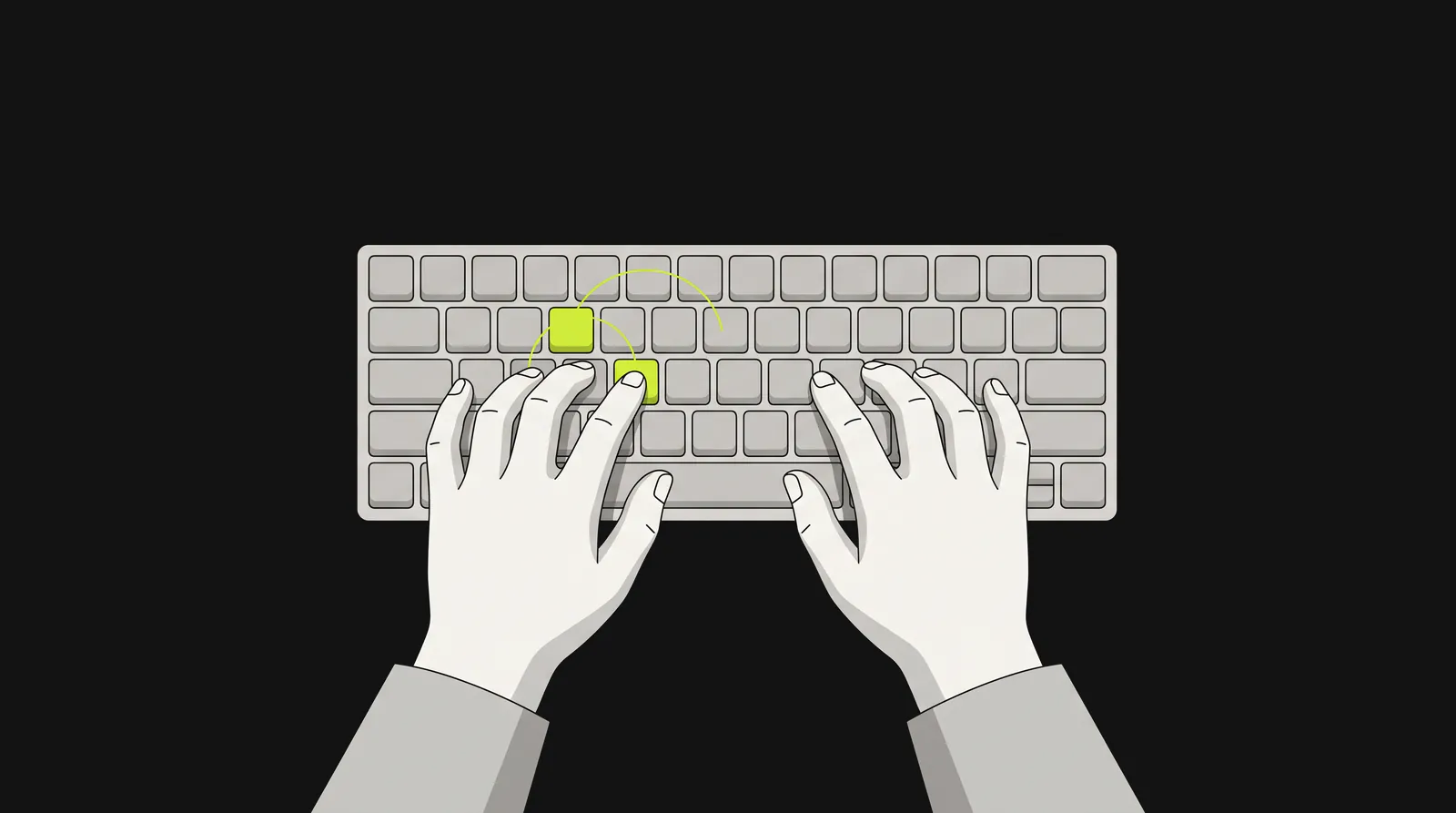
Rollover means pressing the next key before releasing the last one. The fastest 10 percent of typists did it on 50 percent of keys, the slowest 10 percent on 8 percent.
Speed doesn't come from shorter keypresses. Fast typists hold each key down only a little less long than slow ones (104 milliseconds against 129). The difference is the gap between keys: the fastest 10 percent pressed the next key about 122 milliseconds after the last, on average, and the slowest 10 percent about 481 milliseconds after. Rollover was a strong predictor of speed (a correlation of 0.73), and the authors call how common it is "surprising".
The study also sorted people into 8 groups by how they press keys. Their average speeds run from 46.5 to 68.4 WPM, and the two biggest groups sit at opposite ends:
| Typist group (the authors' names) | People | Average speed | Keys pressed with rollover | Errors left (percent) |
|---|---|---|---|---|
| Slow, careful typists | 38,012 | 46.5 WPM | 20 percent | 1.26 |
| Slow, careless hand alternators | 12,930 | 48.1 WPM | 19 percent | 1.31 |
| Average but error-prone | 13,397 | 52.4 WPM | 24 percent | 1.26 |
| Average right-hand typists | 15,498 | 53.1 WPM | 26 percent | 1.19 |
| Average hand alternators | 7,731 | 53.9 WPM | 21 percent | 1.22 |
| Average typists | 22,980 | 56.5 WPM | 27 percent | 1.15 |
| Fast, error-prone typists | 19,757 | 64.6 WPM | 36 percent | 1.09 |
| Fast rollovers | 35,068 | 68.4 WPM | 38 percent | 0.97 |
Source: Dhakal and colleagues, CHI 2018, Table 4. The names compare groups of similar speed: "fast, error-prone typists" make more errors than the fast rollovers, not more than everyone.
The faster groups use more rollover and leave fewer errors. The fastest group also presses the fewest extra keys for corrections, so its speed doesn't come from rushing and fixing mistakes later.
What we'd take from this if you want a higher score: use more of your fingers, which the study links to speed; aim for fewer mistakes rather than faster corrections, since slow typists spent more than twice as many keystrokes on corrections; let your keystrokes overlap instead of waiting for each key to come up, which the authors suggest training directly; and track your progress on one test so you can see whether a change helps.
What typing speed do jobs ask for?
In the job postings we checked, keyboard typing requirements ran from about 33 to 80 WPM. Most clerical, dispatch and data entry bars sat between about 33 and 45, and 40 was the most common: the US federal standard for clerk-typist and office automation jobs is 40 WPM on a 5-minute test with 3 or fewer errors, and California's state jobs use the same 40 WPM, 5-minute test. The higher bars came from jobs where typing is the work, like legal secretaries and medical transcriptionists. These are the requirements in real postings we checked on November 10, 2026:
| Job | Typing requirement |
|---|---|
| US federal clerk-typist and office automation jobs | 40 WPM, 5-minute test, 3 or fewer errors (Office of Personnel Management standard) |
| California state Office Technician (Typing) | 40 WPM on a 5-minute certified test |
| 911 dispatcher, Ada County Sheriff's Office, Idaho | 35 WPM |
| School office assistant, Elk Grove Unified School District, California | 35 net WPM on a 5-minute test; internet typing tests not accepted |
| Legal clerk, Los Angeles City Attorney | 35 net WPM, 5 minutes, 5 errors at most |
| Senior legal clerk, Los Angeles City Attorney | 55 net WPM, 5 minutes, 5 errors at most |
| Medical transcriptionist, Kern County Sheriff's Office, California | 45 net WPM |
| Medical transcriptionist, Interlake-Eastern Regional Health Authority, Manitoba | 80 WPM |
| Executive legal secretary at an international law firm | 60 WPM |
| Litigation legal secretary at a US law firm | 70 WPM, transcribing from drafts or dictation |
| Data entry clerk at a records-management company | 10,000 keystrokes per hour at 98 percent accuracy (about 33 WPM) |
| Court reporter (Florida state courts, DC Superior Court) | 225 WPM on a stenotype machine, or in DC also by voice writing |
Most of these bars sit below the 52 WPM typing-test average, so speed alone rules out few practiced typists. Accuracy is the harder part: the federal and Los Angeles tests allow only 3 to 5 errors in 5 minutes, several postings count net WPM, and some won't accept a score from an online test. The fastest requirement isn't keyboard typing at all. Court reporters must capture 225 WPM, and the National Court Reporters Association's certification tests run at 180, 200 and 225 WPM. Florida requires a stenotype, a specialized machine used for court reporting and live captions; the DC Superior Court posting also accepts voice-writing equipment, where the reporter speaks the record.
Typing vs speaking vs reading: how fast words move
Typing is the slowest way most people move words. The fairest comparison with speaking comes from a 2018 study by Stanford, the University of Washington and Baidu, in which the same 24 people copied short phrases of the same kind on the same iPhone, once by keyboard and once by voice:
By voice they entered 153 WPM, by keyboard 52, so speaking was about 2.9 times faster, and voice needed fewer corrections along the way. The study has limits: it ran in a quiet lab, people copied short phrases without punctuation rather than composing, and voice left slightly more errors in the final text (1.30 percent against 0.79). Natural conversation runs at a similar pace, about 164 words per minute per speaker in recorded phone calls, and reading is faster still. You can check your own rates with our speaking time calculator and reading speed test.
It wasn't always this way. In the 1999 IBM study, the same people produced 13.6 corrected words per minute by voice when copying, against 32.5 by keyboard, and 7.8 by voice when composing, against 19.0 by keyboard. As the 2018 paper summed it up, the accuracy of speech input back then "was far inferior to desktop keyboard input". We found no study that has timed people composing by voice with today's speech recognition, and composing takes thinking time however you enter the words. What speaking removes is the limit your typing speed puts on how fast the words come out once you know them.
If you write a lot: Dictation Daddy
If you type at the US adult median of 38 WPM, or 52 if you practice on typing tests, speaking is the faster input you already have. That's the idea behind Dictation Daddy, which we make. You talk, and it types what you said into whatever app has your cursor, on Mac, Windows, Android (where it installs as a keyboard) and as a Chrome extension; the iPhone app is coming soon. It adds punctuation and paragraph breaks from how you speak, so you don't say "comma" or "new paragraph", and it reaches 98 to 99 percent accuracy from your first sentence, about 1 to 2 errors per 100 words. Your first 100 dictations are free, with no credit card needed.
The tradeoff is that Dictation Daddy uses cloud processing, so it needs an internet connection and your audio does leave your device. Full disclosure: you're reading this on the Dictation Daddy website, so we're a little biased. See what real users are saying. For where dictation saves time and where it doesn't, read why dictation is better than typing.
Bottom line
The average US adult types about 38 WPM on a computer and about 29 on a phone; people who take typing tests average about 52. A good speed is 60 WPM or more, which beats about 3 in 4 US adults and meets almost every typing requirement we found. Past that, your test score matters less than you'd think, because writing your own words runs far slower than copying. If you write all day, speaking was about three times faster than typing in the one modern study that timed the same people both ways. Try Dictation Daddy free.
FAQ
What is the average typing speed for adults?
About 38 WPM on a computer. A 2026 study of 10,613 US adults chosen to represent the country found a median of 37.8 WPM on a computer and 29.4 on a phone, adjusted for errors. People who take online typing tests are faster: 168,960 of them averaged 52 WPM in a 2018 study.
What is a top 1 percent typing speed?
Around 100 WPM. The largest study doesn't publish a top 1 percent cut-off, but a bell curve built from its published average and spread puts it near 100 WPM, and the study's fastest typists reached 120 WPM or more.
Does age affect typing speed?
Across whole populations, yes. In the 2026 study of US adults, typing speed fell steadily with age on computers and on phones. Among 2,690 Dutch hospital staff, those 29 and under averaged 69.9 WPM and those 60 and over 35.2, adjusted for errors. On phones, a study of 37,370 people found averages falling from 39.6 WPM for ages 10 to 19 to 26.3 WPM for ages 50 to 59. Practiced typists may be the exception: a 1984 study of typists aged 19 to 72 found that the older ones "were not slower in speed of typing", apparently because they read further ahead in the text.
What is the fastest typing speed ever recorded?
Guinness World Records lists Stella Pajunas, who typed 216 words in one minute on an IBM machine in Chicago in an official test in 1946. For sustained speed, the 1985 Guinness book listed Barbara Blackburn as able to keep up 150 WPM for 50 minutes on a Dvorak keyboard; the 212 WPM often quoted for her was her own claim, not a Guinness figure. Today the fastest results on Monkeytype's public leaderboard are about 319 WPM for 15 seconds and 288 WPM for 60 seconds (checked November 10, 2026), typed on words drawn from the 200 most common in English rather than full sentences.
How many words per minute do people speak?
Usually 150 to 200 words per minute. In 2,438 recorded phone conversations, each speaker averaged about 164 words per minute across their turns (Yuan, Liberman and Cieri, 2006), and in 1,656 video calls recorded in 2020 people spoke at 3.3 words a second, about 198 a minute (Reece and colleagues, 2023). The 150 that many sites use, ours included, is on the slow side of these measurements.
How do I test my typing speed?
Type a passage for a fixed time, divide the correct characters by 5 to get words, then divide by the minutes. Our free typing test does this for 15, 30 or 60 seconds and shows your accuracy. If you're preparing for a job test, also practice for 5 minutes at a time.
Ready to try it?
Turn your voice into polished text
Free for your first 100 dictations. Works in every app. No credit card required.